
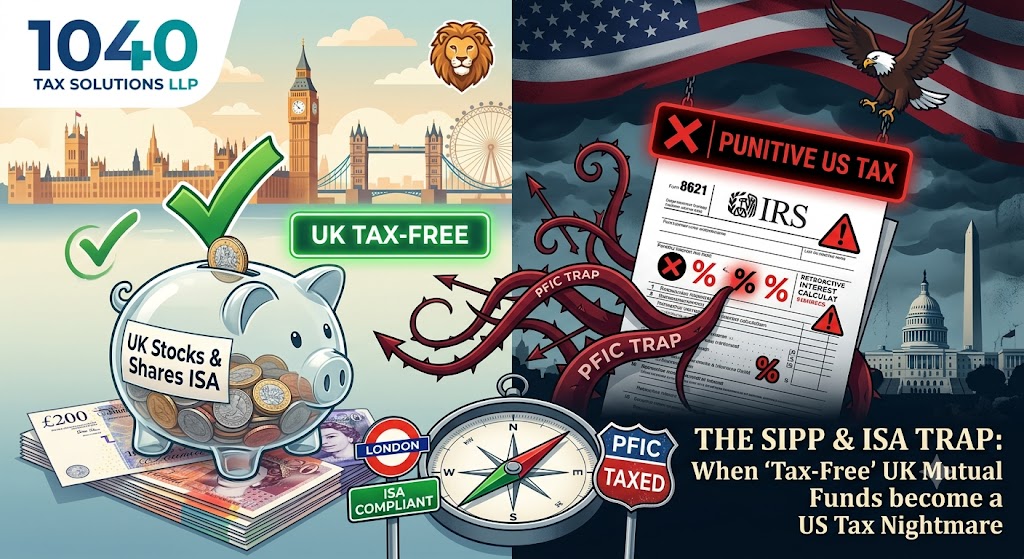
You’ve relocated to the UK, settled into your new routine, and opened a local UK bank or brokerage account. Like any financially savvy individual, you want to build wealth. Naturally, you look toward the UK’s most popular, tax-efficient investment vehicle: the Stocks & Shares ISA (Individual Savings Account).
To a UK resident, an ISA is a financial no-brainer. It allows you to invest up to £20,000 per year, and any capital gains or dividend income generated inside it is 100% tax-free under UK law.
But as a US citizen or Green Card holder living in the UK, there is a massive catch.
Under the hood of almost every Stocks & Shares ISA lies a complex, highly punitive US tax trap known as a PFIC (Passive Foreign Investment Company). If you aren’t careful, what seems like a tax-free haven in London can trigger eye-watering tax rates, complex accounting fees, and retroactive interest penalties from the IRS.
Here is a breakdown of why this trap exists, how it works, and how you can protect your wealth as a dual-jurisdiction taxpayer.
What is a PFIC, and Why Does the IRS Care?
A Passive Foreign Investment Company (PFIC) is any foreign (non-US) entity that meets one of two criteria:
-
The Income Test: At least 75% of its gross income is passive (such as interest, dividends, or capital gains).
-
The Asset Test: At least 50% of its assets are held to produce passive income.
In plain English, almost every foreign-domiciled pooled investment fund is a PFIC.
This includes:
-
UK Unit Trusts
-
UK Mutual Funds
-
European ETFs (Exchange Traded Funds)
-
Foreign Investment Trusts
The IRS created the PFIC rules in 1986 to prevent US taxpayers from hiding cash in offshore mutual funds to defer US taxes. While intended to target wealthy individuals shielding money in tax havens, the law was written so broadly that it sweeps up standard, everyday UK investment funds.
The ISA Illusion: The US Doesn’t Recognize UK Tax-Free Status
The core of the problem is a clash of tax treaties. While the US-UK Tax Treaty generally recognizes the tax-deferred status of UK pensions (like workplace pensions or SIPPs), it does not recognize the Stocks & Shares ISA.
To HMRC, your ISA is invisible for tax purposes. To the IRS, your ISA is just a standard, taxable brokerage account.
If you buy a UK mutual fund or a European ETF inside your ISA, the IRS ignores the “tax-free” wrapper entirely. They look directly at the underlying investment, flag it as a PFIC, and apply some of the most aggressive tax rates in the entire Internal Revenue Code.
How the PFIC “Default” Tax Penalty Works
If you hold a PFIC and do not make any special tax elections, the IRS subjects your investment to the Default Section 1291 Taxation Rules. Under these rules:
1. Excess Distributions are Taxed at the Highest Bracket
Any gain you realize when you sell the fund (or any “excess distribution” dividend you receive) is not taxed at the favorable US capital gains rate (which maxes out at 20% for most people). Instead, it is taxed as ordinary income at the absolute highest marginal tax rate for that tax year—which can be up to 37%.
2. The Tax is Allocated Retroactively
The IRS assumes you earned that profit evenly over every single year you held the investment. They allocate the gain backward across your holding period, taxing you at the highest rate for each historical year.
3. Interest Penalties Accumulate
Because the IRS views this as “deferred tax” that you should have paid in those previous years, they charge you compounded, daily interest on the tax you owe for each of those prior years. By the time you sell, more than 50% of your total investment gains can easily vanish in US taxes and interest.
The Compliance Nightmare: Form 8621
Even if your UK investment doesn’t grow or distribute income, simply owning a PFIC triggers a massive reporting burden.
You are required to file IRS Form 8621 (Information Return by a Shareholder of a Passive Foreign Investment Company) every single year for each individual PFIC you own.
If you hold an ISA with five different UK mutual funds, you must complete five separate Forms 8621. The IRS itself estimates that completing a single Form 8621 takes over 20 hours of record-keeping and tax preparation. Because of this extreme complexity, most expat accountants charge hundreds of dollars per form, easily wiping out any investment returns you made during the year.
How to Protect Your Wealth: Expat-Safe Strategies
Fortunately, you do not have to give up on investing entirely. There are several compliant, tax-efficient strategies you can use to build wealth while living in the UK:
-
Focus on US-Domiciled ETFs & Stocks: The simplest way to avoid the PFIC trap is to buy US-domiciled stocks, bonds, or US-registered ETFs. Because these are US corporations, they are not classified as foreign passive investments. (Note: You must ensure your UK broker allows you to purchase US ETFs under European PRIIPs regulations, or opt for individual US stocks).
-
Utilize Your UK SIPP/Pension: While ISAs do not enjoy treaty protection, qualified UK pensions generally do. Investing through a SIPP (Self-Invested Personal Pension) or employer-sponsored pension allows you to access UK funds without triggering immediate PFIC reporting or punitive taxation on the US side.
-
Consult a Dual-Status Tax Advisor: If you already own PFICs, a specialized cross-border tax professional can help you make specific tax elections (such as a QEF Election or Mark-to-Market Election) to significantly reduce the tax damage and simplify your annual reporting.
Don’t Let the IRS Erase Your UK Savings
Building a life abroad shouldn’t mean sacrificing your financial future. If you currently hold a UK Stocks & Shares ISA, or if you are planning to start investing in the UK, getting professional cross-border advice before you purchase a fund is the single best financial decision you can make.
Are you concerned your UK investments might be triggering IRS penalties?
Schedule an Expat Tax Assessment with our team today. We specialize in dual-jurisdiction US/UK tax compliance and can help you structure your investments safely, cleanly, and profitably.